Some project examples
pick one to explore
September 2026
Lumentum: End-to-End Optical Communication
An IEEE Concordia project sending real-time text through a free-space laser link — PC to microcontroller to laser transmitter, across open air, into a photodiode receiver, and back.
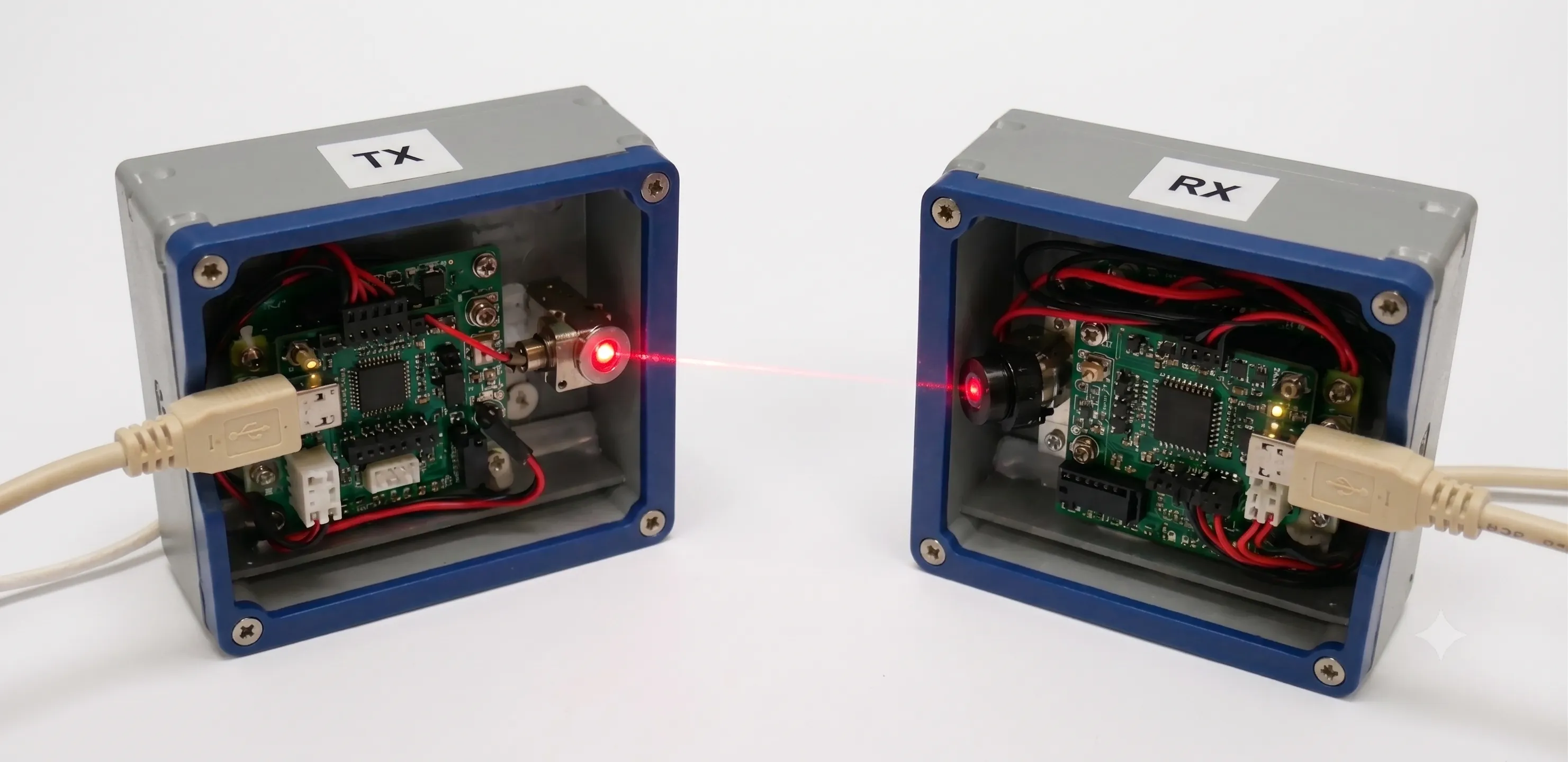
Lumentum is an IEEE Concordia Student Branch project I lead: a compact, enclosed system that sends digital data from one computer to another entirely through light.
The chain
A message typed on one computer travels through the full stack before it reappears on a second:
PC → Microcontroller → Laser Transmitter → Free-Space Optical Channel → Photodiode Receiver → Microcontroller → PC
The primary demo is real-time text communication — type on one machine, watch the reconstructed message arrive on another after being carried across the room on a beam of light.
Why it’s a good platform
It’s a single project that forces every discipline to work together: embedded firmware, analog front-end design, PCB layout, and optical communication theory, all in one enclosure the size of a lunchbox.
Receiver — analog front end
A BPW34 photodiode feeds a transimpedance amplifier (OPA380) and comparator (MCP6562), with feedback resistor and compensation capacitor values derived from bench-measured photodiode capacitance and expected current — simulated before anything gets soldered.
Transmitter — laser driver
A 650 nm, 5 mW Class 3R laser module, driven through an SN74AHCT125N to step 3.3 V logic up to 5 V, with current limiting and a safety sign-off process (Concordia EHS, enclosed beam path, power-off alignment) before it’s ever powered on.
Firmware — the packet layer
A shared packet format — preamble, start marker, payload type, length, payload, CRC — implemented once as a shared encoder/decoder so the transmit and receive firmware teams build against the same contract. Clock recovery and bit-rate are sized to whatever the laser module measures out at on the bench, not a number picked in advance.
PCB
Full schematic capture and layout, with test points on every analog stage and header breakout between the analog and digital sections so debugging doesn’t require reflowing anything.
Team structure
Six people across four roles — analog/optical, laser transmitter, mechanical/enclosure, and firmware (packet layer, transmit, receive) — with weekly measurement checkpoints so component values in the PCB always trace back to something actually measured on the bench, not a datasheet typical.
Optical communication is a nice project because you can’t fake your way past physics — every stage either passes a clean signal to the next one or it doesn’t, and you find out on the scope.
August 2026
Demson: Motion Intelligence for Strength Training
A smart compression training suit with motion sensors woven into the fabric, coaching form corrections through your earbuds mid-set — not in a report after the workout is over.

Demson is a strength coach built into the clothes you already train in. I’m co-founding it with Eithan Kuri Valdovinos and Sepehr Ghasemzadeh-Moghaddam, currently prototyping through District 3 in Montreal.
The problem
Most lifters don’t notice when their form breaks down. Fatigue accumulates over a set, posture shifts a few degrees at a time, and nobody catches it until the strain shows up in a knee or a back the next day — by which point the damage is already done.
The people who need feedback most get the least of it. Beginners haven’t built the movement awareness to catch their own mistakes. Anyone training alone has no second set of eyes. And the existing fixes don’t close the gap: personal trainers aren’t affordable at daily frequency, camera apps need a tripod and clear sightlines that don’t exist inside a squat rack, and wearables like watches and chest straps measure how much you trained, not how well you moved. None of them can see abdominal bracing — the intra-abdominal pressure that stabilizes your spine under load — because it’s invisible from the outside.
The approach
Demson is compression training wear with fabric stretch sensors built into the garment, paired with software that delivers form cues through your earbuds while you’re still mid-set. Depth is short. Your right side is loading harder. Your brace is gone. The timing is the whole point — a report after the workout is useless for the rep that ends up hurting you.
- Integrated textile sensing: conductive pathways woven into breathable technical knit, no bulky external sensors to strap on.
- Live motion tracking: a synchronized digital visualization of your movement during each rep.
- Real-time coaching: cues delivered mid-set as form starts to deteriorate.
- Session memory: joint angles, load symmetry, depth consistency, and fatigue trends tracked across a full week on one charge.
Where it’s at
A leg sleeve prototype focused on squats is currently being built, with real-time coaching feedback and full-body tracking as the next milestones. Our customer target is intermediate-to-advanced lifters, 25–40, who train alone or with minimal coaching and have either had a lifting injury or are actively worried about one.
The interesting engineering problem isn’t the sensor — it’s proving the sensor response actually maps to something as invisible as bracing, and doing it in real time, on a device someone’s willing to wear every day.
July 2026
Wireless Microphone Pendant
An ultra-miniature wearable audio transmitter disguised as a necklace pendant — low-latency 2.4 GHz streaming, onboard Li-Po charging, and a full RF front end squeezed into jewelry-scale board space.
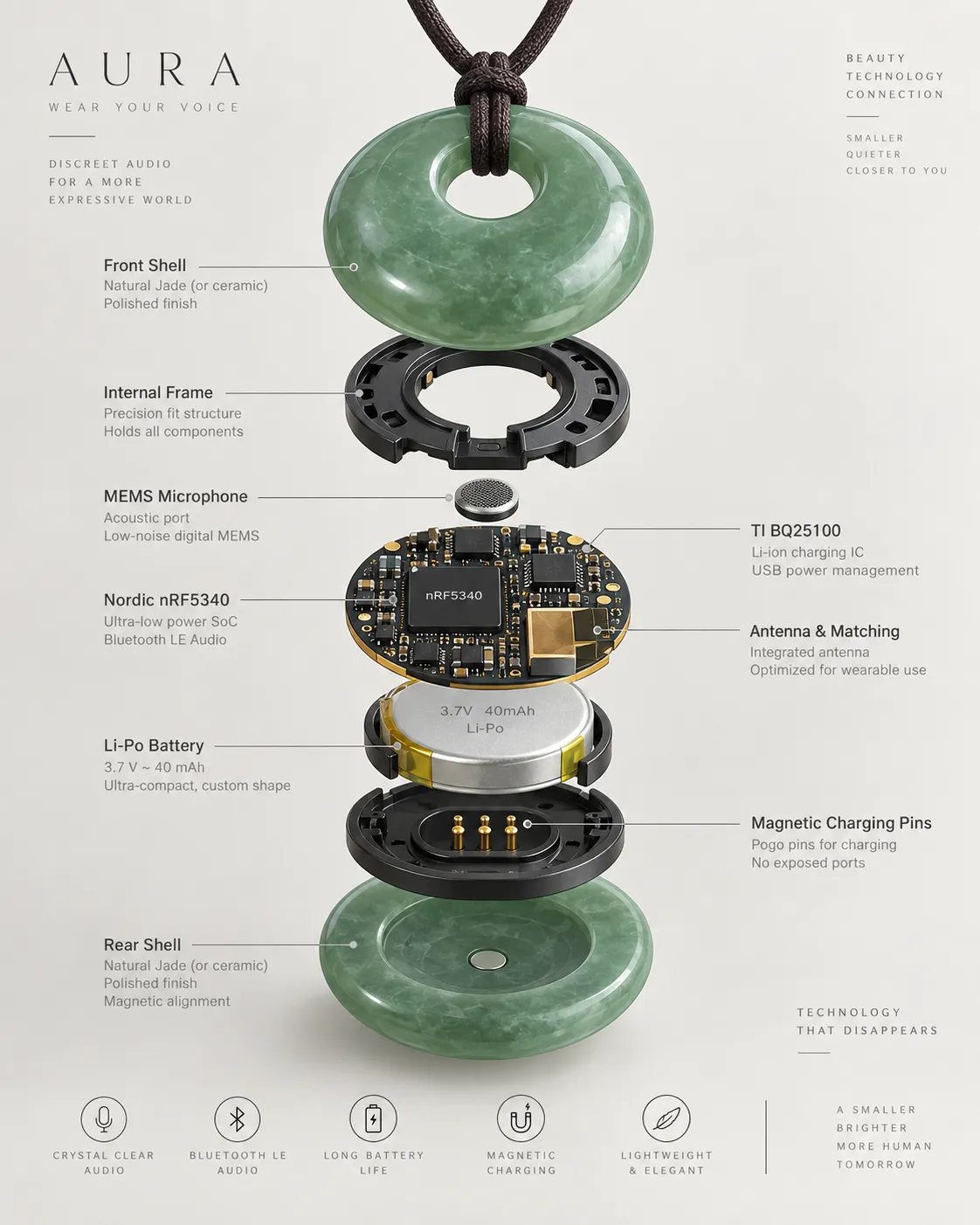
A wearable wireless audio transmitter, small enough to disappear inside a pendant necklace, built for discreet, high-quality audio streaming.
Concept render of the proposed pendant architecture.
Architecture
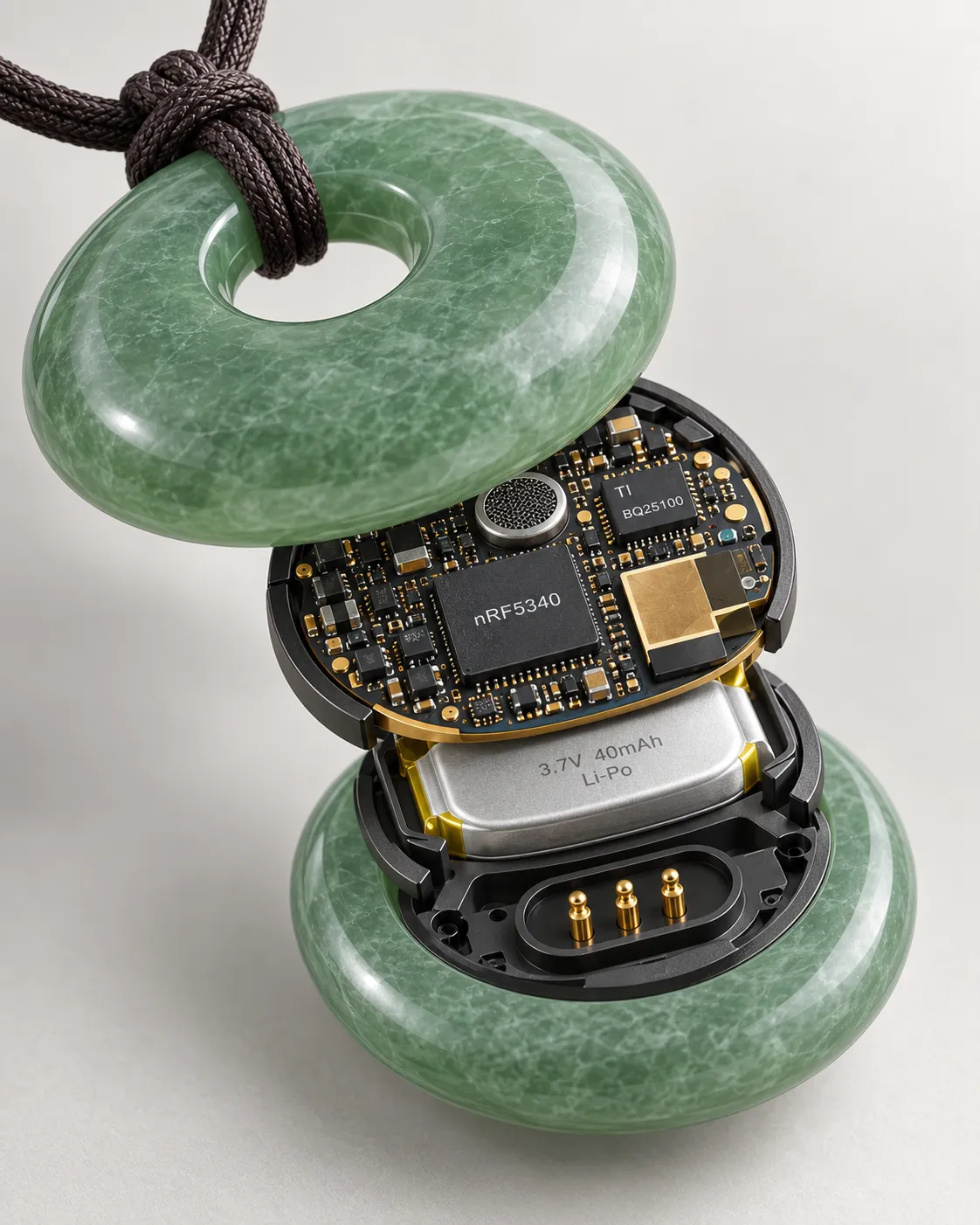
The board is built around the Nordic Semiconductor nRF5340 — a dual-core SoC with an application Cortex-M33 alongside a dedicated network core handling low-latency 2.4 GHz / Bluetooth LE Audio transmission. Running the SoC in High Voltage mode lets it take battery voltage directly from a micro single-cell Li-ion/Li-Po pack and regulate downstream rails internally, cutting out the bulky discrete buck converter a lower-voltage design would need.
Charging is handled onboard by a TI BQ25100 linear charger, tuned for the sub-100 mA currents that suit a small-capacity cell without cooking it. A MEMS microphone front end handles audio input, chosen for ambient noise rejection and speech intelligibility over raw fidelity — the pendant needs to sound like a person talking in a room, not like a studio mic.
The real constraint: space
Everything on this board is downstream of one problem — it has to fit inside jewelry. Schematic capture and layout were done in KiCad 8.0, working against micro-via constraints, tight RF impedance matching on the antenna feed, and mechanical clearances dictated by the pendant enclosure rather than the usual PCB house rules. The RF matching network and the charging circuit both had to hit their targets without the board footprint growing past what the enclosure would tolerate.
Stack
Nordic nRF5340 · TI BQ25100 · MEMS microphone · 2.4 GHz antenna matching network · KiCad 8.0
The fun part of this one wasn’t the RF or the firmware — it was watching how much a power budget and a board outline can constrain every other decision once “small enough to wear” becomes a hard requirement instead of a nice-to-have.