
Demson: Motion Intelligence for Strength Training
A smart compression training suit with motion sensors woven into the fabric, coaching form corrections through your earbuds mid-set — not in a report after the workout is over.
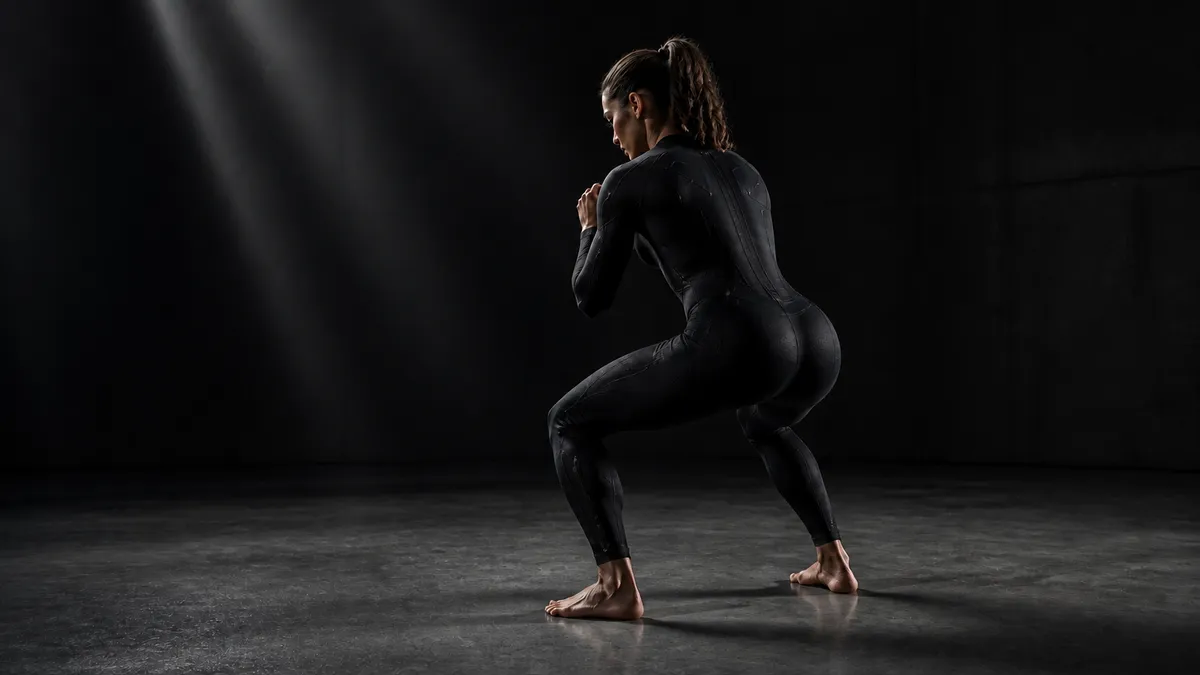
Demson is a strength coach built into the clothes you already train in. I’m co-founding it with Eithan Kuri Valdovinos and Sepehr Ghasemzadeh-Moghaddam, currently prototyping through District 3 in Montreal.
The problem
Most lifters don’t notice when their form breaks down. Fatigue accumulates over a set, posture shifts a few degrees at a time, and nobody catches it until the strain shows up in a knee or a back the next day — by which point the damage is already done.
The people who need feedback most get the least of it. Beginners haven’t built the movement awareness to catch their own mistakes. Anyone training alone has no second set of eyes. And the existing fixes don’t close the gap: personal trainers aren’t affordable at daily frequency, camera apps need a tripod and clear sightlines that don’t exist inside a squat rack, and wearables like watches and chest straps measure how much you trained, not how well you moved. None of them can see abdominal bracing — the intra-abdominal pressure that stabilizes your spine under load — because it’s invisible from the outside.
The approach
Demson is compression training wear with fabric stretch sensors built into the garment, paired with software that delivers form cues through your earbuds while you’re still mid-set. Depth is short. Your right side is loading harder. Your brace is gone. The timing is the whole point — a report after the workout is useless for the rep that ends up hurting you.
- Integrated textile sensing: conductive pathways woven into breathable technical knit, no bulky external sensors to strap on.
- Live motion tracking: a synchronized digital visualization of your movement during each rep.
- Real-time coaching: cues delivered mid-set as form starts to deteriorate.
- Session memory: joint angles, load symmetry, depth consistency, and fatigue trends tracked across a full week on one charge.
Where it’s at
A leg sleeve prototype focused on squats is currently being built, with real-time coaching feedback and full-body tracking as the next milestones. Our customer target is intermediate-to-advanced lifters, 25–40, who train alone or with minimal coaching and have either had a lifting injury or are actively worried about one.
The interesting engineering problem isn’t the sensor — it’s proving the sensor response actually maps to something as invisible as bracing, and doing it in real time, on a device someone’s willing to wear every day.