
Lumentum: End-to-End Optical Communication
An IEEE Concordia project sending real-time text through a free-space laser link — PC to microcontroller to laser transmitter, across open air, into a photodiode receiver, and back.
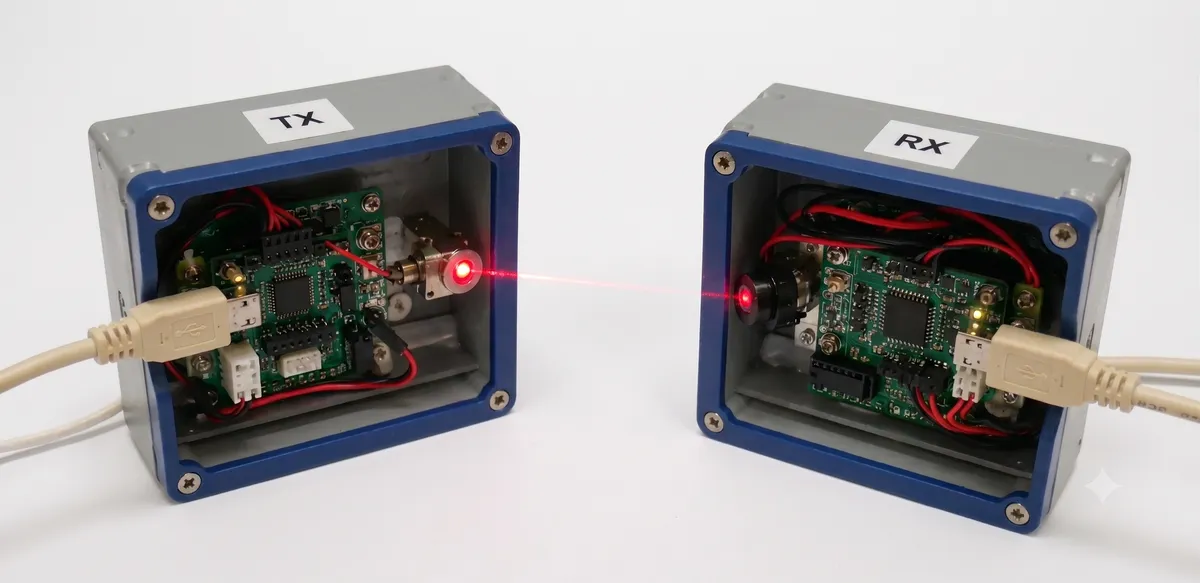
Lumentum is an IEEE Concordia Student Branch project I lead: a compact, enclosed system that sends digital data from one computer to another entirely through light.
The chain
A message typed on one computer travels through the full stack before it reappears on a second:
PC → Microcontroller → Laser Transmitter → Free-Space Optical Channel → Photodiode Receiver → Microcontroller → PC
The primary demo is real-time text communication — type on one machine, watch the reconstructed message arrive on another after being carried across the room on a beam of light.
Why it’s a good platform
It’s a single project that forces every discipline to work together: embedded firmware, analog front-end design, PCB layout, and optical communication theory, all in one enclosure the size of a lunchbox.
Receiver — analog front end
A BPW34 photodiode feeds a transimpedance amplifier (OPA380) and comparator (MCP6562), with feedback resistor and compensation capacitor values derived from bench-measured photodiode capacitance and expected current — simulated before anything gets soldered.
Transmitter — laser driver
A 650 nm, 5 mW Class 3R laser module, driven through an SN74AHCT125N to step 3.3 V logic up to 5 V, with current limiting and a safety sign-off process (Concordia EHS, enclosed beam path, power-off alignment) before it’s ever powered on.
Firmware — the packet layer
A shared packet format — preamble, start marker, payload type, length, payload, CRC — implemented once as a shared encoder/decoder so the transmit and receive firmware teams build against the same contract. Clock recovery and bit-rate are sized to whatever the laser module measures out at on the bench, not a number picked in advance.
PCB
Full schematic capture and layout, with test points on every analog stage and header breakout between the analog and digital sections so debugging doesn’t require reflowing anything.
Team structure
Six people across four roles — analog/optical, laser transmitter, mechanical/enclosure, and firmware (packet layer, transmit, receive) — with weekly measurement checkpoints so component values in the PCB always trace back to something actually measured on the bench, not a datasheet typical.
Optical communication is a nice project because you can’t fake your way past physics — every stage either passes a clean signal to the next one or it doesn’t, and you find out on the scope.