
Wireless Microphone Pendant
An ultra-miniature wearable audio transmitter disguised as a necklace pendant — low-latency 2.4 GHz streaming, onboard Li-Po charging, and a full RF front end squeezed into jewelry-scale board space.
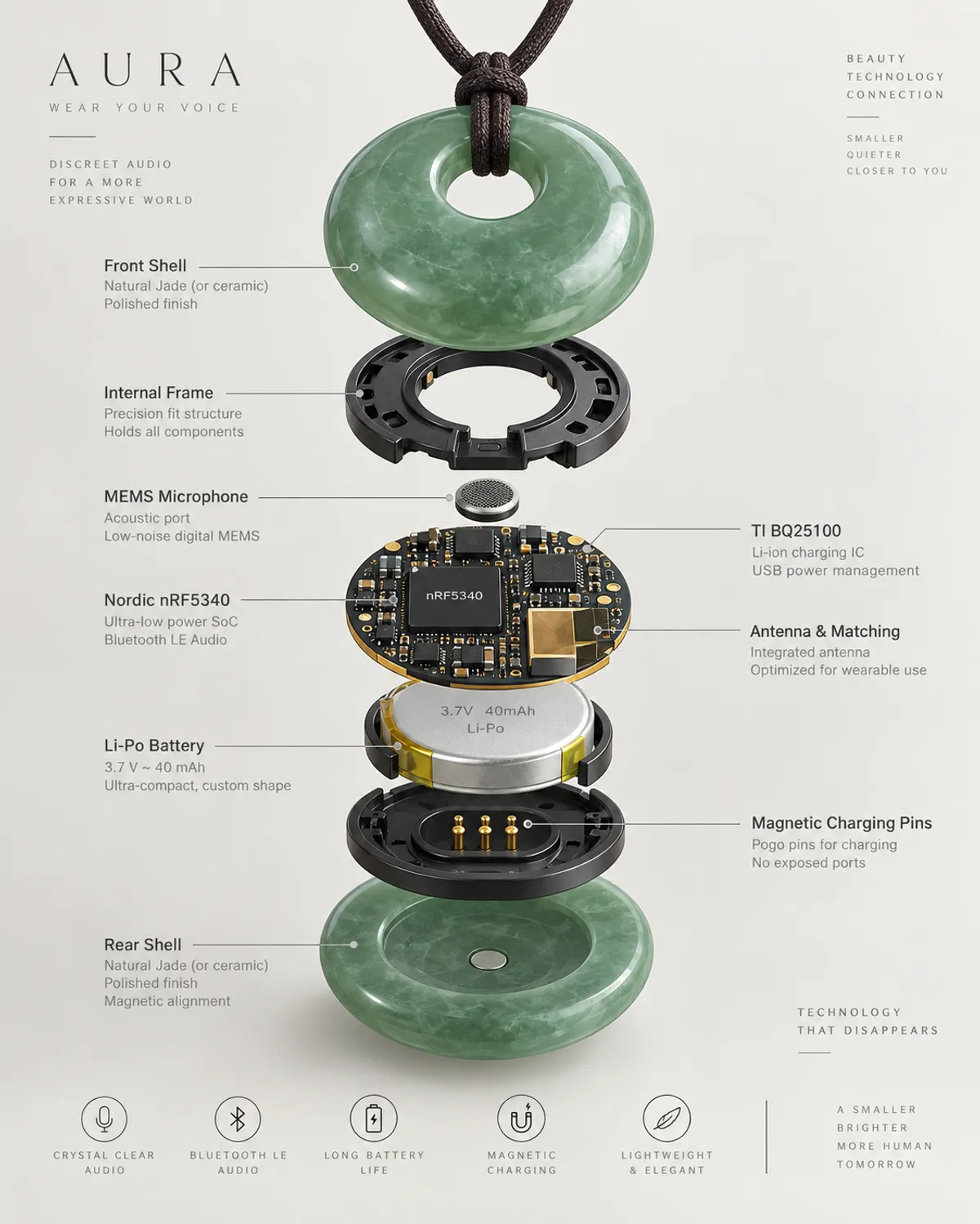
A wearable wireless audio transmitter, small enough to disappear inside a pendant necklace, built for discreet, high-quality audio streaming.
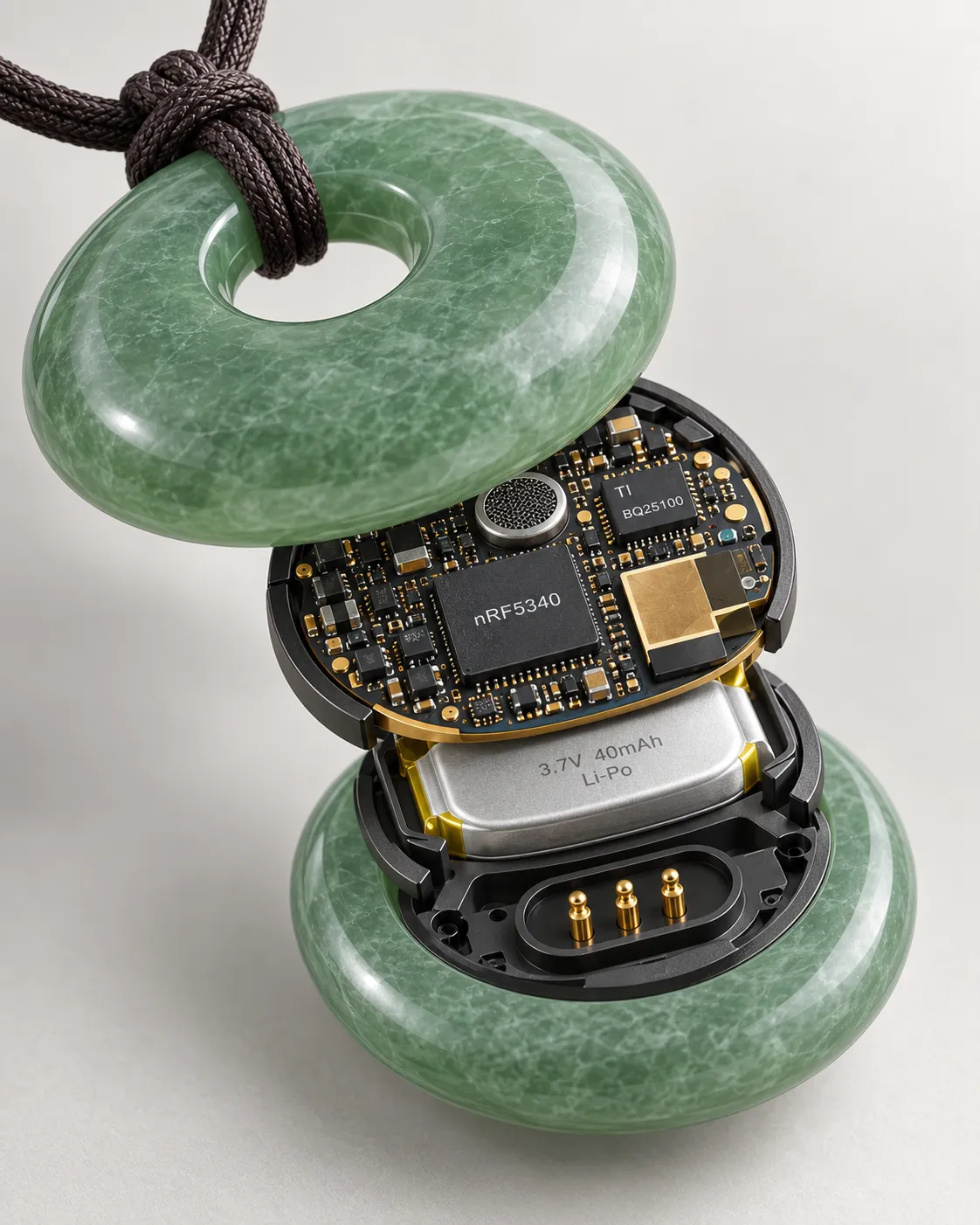
Concept render of the proposed pendant architecture.
Architecture
The board is built around the Nordic Semiconductor nRF5340 — a dual-core SoC with an application Cortex-M33 alongside a dedicated network core handling low-latency 2.4 GHz / Bluetooth LE Audio transmission. Running the SoC in High Voltage mode lets it take battery voltage directly from a micro single-cell Li-ion/Li-Po pack and regulate downstream rails internally, cutting out the bulky discrete buck converter a lower-voltage design would need.
Charging is handled onboard by a TI BQ25100 linear charger, tuned for the sub-100 mA currents that suit a small-capacity cell without cooking it. A MEMS microphone front end handles audio input, chosen for ambient noise rejection and speech intelligibility over raw fidelity — the pendant needs to sound like a person talking in a room, not like a studio mic.
The real constraint: space
Everything on this board is downstream of one problem — it has to fit inside jewelry. Schematic capture and layout were done in KiCad 8.0, working against micro-via constraints, tight RF impedance matching on the antenna feed, and mechanical clearances dictated by the pendant enclosure rather than the usual PCB house rules. The RF matching network and the charging circuit both had to hit their targets without the board footprint growing past what the enclosure would tolerate.
Stack
Nordic nRF5340 · TI BQ25100 · MEMS microphone · 2.4 GHz antenna matching network · KiCad 8.0
The fun part of this one wasn’t the RF or the firmware — it was watching how much a power budget and a board outline can constrain every other decision once “small enough to wear” becomes a hard requirement instead of a nice-to-have.